

An Honest Opinion: Are Expensive Cashmere Sweaters Worth It?
I’ve been there. Standing in a beautifully lit store, fingers tracing the impossibly soft fabric of a sweater. I glance at the tag, and my breath catches. That can’t be right. Three digits—sometimes starting with a number I’m not entirely comfortable with—for a single piece of clothing. My mind immediately starts doing the math: that’s a week of groceries, a couple of tanks of gas, a significant chunk of the kids’ activity fees. I fold it carefully, place it back on the polished wooden table, and walk away with a sigh.
The allure of a 100% cashmere sweater is powerful, but the price tag can feel like a barrier to entry. For years, I preached the gospel of ‘quality over quantity,’ a philosophy I still stand by. But even I had to ask myself: is this particular luxury staple truly a worthwhile investment, or is it just a status symbol with a high cost of ownership? It’s one of the most common questions I get, so I decided it was time to really dive in. I’m pulling back the curtain on my own experience, analyzing the cost-per-wear, the essential care routines, and how it stacks up against more affordable options to give you my final, honest verdict.
First, What Makes Cashmere So Special (and So Expensive)?
Before we can talk about value, we have to understand what we’re paying for. Cashmere isn’t just wool from a fancy sheep. It’s a specific fiber from the fine, downy undercoat of cashmere goats. These goats live in harsh, cold climates, and this super-soft layer is what keeps them warm.
Here’s the kicker: the fibers are harvested by hand-combing the goats during their natural shedding season in the spring. A single goat produces only a few ounces of this precious fiber each year—sometimes just enough for a scarf. It can take the fleece of two to four goats to make a single sweater. When you factor in the delicate harvesting process, the cleaning, the sorting of the fibers by quality (longer, finer fibers are more expensive and less prone to pilling), and the expert spinning and knitting, that price tag starts to make a little more sense.
The result is a fabric that’s up to eight times warmer than sheep’s wool, yet incredibly lightweight and breathable. It doesn’t have the itch-factor of traditional wool, and when you slip it on, it feels less like clothing and more like a gentle, comforting hug. It’s the very definition of everyday luxury.
Let’s Talk Numbers: The Power of Cost-Per-Wear
As a former corporate strategist, I can’t help but look at things through a practical, analytical lens. My approach to building an investment wardrobe is no different. The initial price of an item is only one part of the equation. The real story is in the cost-per-wear (CPW).
CPW is simple: Total Cost of Item ÷ Number of Times Worn = Cost-Per-Wear.
Let’s imagine a classic, high-quality, 100% cashmere crewneck sweater that costs $350. It’s an intimidating number, I know. But let’s be realistic about how you’d wear it. It’s a timeless piece you could wear for work-from-home video calls, weekend errands, and cozy evenings in. If you wear it just 15 times between fall and spring, that’s $23.33 per wear in the first year.
But a well-cared-for cashmere sweater isn’t a one-season wonder. It’s a lifetime piece. Let’s say you wear it 15 times a year for five years (a very conservative estimate). That’s 75 wears.
$350 ÷ 75 wears = $4.67 per wear.
Now, compare that to a trendy, $60 acrylic sweater from a fast-fashion brand. It looks great for a few wears, but it starts pilling and losing its shape after a handful of washes. Maybe you get one season—15 wears—out of it before it looks tired. That’s a CPW of $4.00. It seems cheaper, but you have to replace it every single year. Over five years, you’d spend $300 on subpar sweaters that never felt as good or looked as elegant as the single cashmere piece. Suddenly, the investment piece doesn’t just feel better—it makes financial sense, too.
The Catch: An Investment Requires Maintenance
Here’s the part where I get brutally honest. A cashmere sweater is not a “buy it and forget it” item. You can’t just toss it in the hamper with your kids’ soccer jerseys and hope for the best. That low cost-per-wear I just calculated? It’s entirely dependent on you treating this garment with the respect it deserves. The good news is, it’s easier than you think.
My Tried-and-True Cashmere Care Routine
- Wash Sparingly: Cashmere is naturally breathable and antibacterial. You don’t need to wash it after every wear. I typically wash my sweaters every 4-5 wears, unless something gets spilled on them.
- Hand-Wash is Best: It sounds daunting, but it’s a 15-minute task. Fill a clean basin with cool water and a small amount of a gentle, pH-neutral detergent made for wool and cashmere. Submerge the sweater, gently squeeze the suds through it (never wring or twist!), and let it soak for 10 minutes.
- Rinse and Reshape: Drain the soapy water and rinse with cool, clean water until the suds are gone. Gently squeeze out the excess water. Place the sweater on a thick, clean towel, roll it up like a jelly roll, and press firmly to absorb more water.
- Lay Flat to Dry: Unroll the sweater and lay it flat on a fresh, dry towel or a mesh drying rack, away from direct sunlight or heat. Reshape it to its original dimensions. Never, ever hang a wet cashmere sweater—the weight of the water will stretch it out permanently.
- Storage is Key: In the off-season, make sure your sweaters are clean, and then fold them neatly. Store them in a breathable garment bag with some cedar blocks or lavender sachets to deter moths.
A Note on Pilling (Because It Happens!)
I remember the first time I noticed tiny little balls of fluff forming on the underarms of my first “real” cashmere sweater. I panicked. Did I buy a dud? Did I ruin it? The truth is, pilling is a natural characteristic of fine animal fibers. It’s caused by friction—where your arms rub against your body, or where your purse strap sits. Even the most expensive cashmere will pill a bit, especially when it’s new.
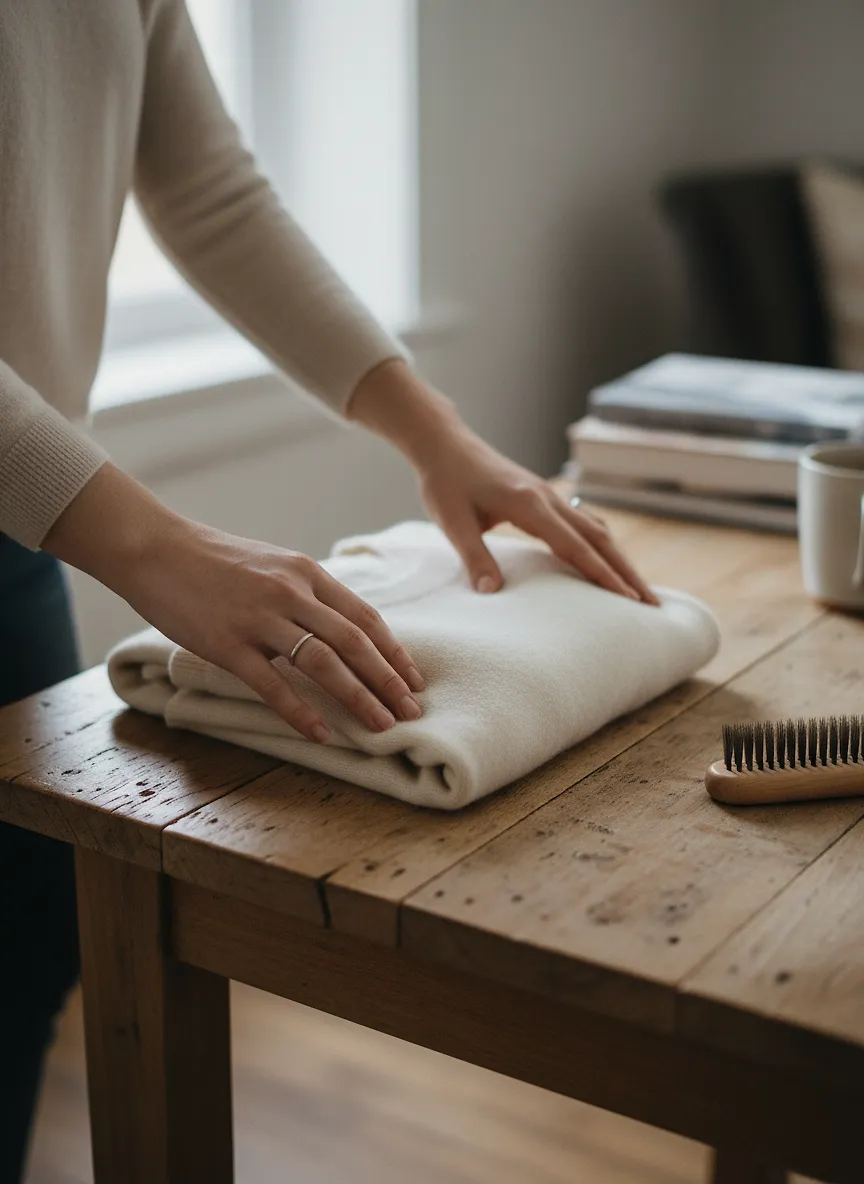
The solution isn’t to stop wearing it; it’s to manage it. Invest in a small, inexpensive cashmere comb or a fabric shaver. Lay the sweater on a flat surface and gently glide the comb over the pilled areas. It takes two minutes and leaves your sweater looking brand new. It’s a small, almost meditative ritual that’s part of the ownership experience.
The Contenders: How Do Cheaper Alternatives Stack Up?
Okay, so maybe a $350 sweater just isn’t in the cards right now. I get it. What are the other options, and are they any good?
Cashmere Blends
You’ll often see sweaters labeled “cashmere blend,” which usually means a small percentage of cashmere (sometimes as low as 5-10%) is blended with wool, silk, or synthetic fibers like nylon. These are more affordable, but you lose some of that signature cashmere magic. They won’t be as soft or as warm, and blends with synthetics can be more prone to stubborn pilling and won’t be as breathable.
Merino Wool
In my opinion, high-quality merino wool is the absolute best alternative to cashmere. It comes from merino sheep and has many of the same amazing properties: it’s soft (though not *quite* as cloud-like as cashmere), it’s excellent at regulating body temperature, it’s breathable, and it’s naturally odor-resistant. It’s also more durable and generally less expensive. A great merino wool sweater is a fantastic investment and a cornerstone of my guide to building a minimalist loungewear capsule wardrobe. It’s the perfect intersection of comfort, quality, and value.
Recycled Cashmere
A growing number of sustainable brands are using recycled cashmere, made from post-consumer yarn that is sorted, shredded, and re-spun. This is a wonderful, eco-friendly option that reduces waste. The fibers are shorter, so it may not feel quite as buttery soft as virgin cashmere, but it’s a purchase you can feel fantastic about.
My Final Verdict: So, Are They Worth It?
After years of owning, wearing, and caring for cashmere, my answer is a resounding… yes, but with a few important conditions.
An expensive cashmere sweater is worth it if:
- You choose a timeless style and color. Don’t drop a fortune on a trendy, of-the-moment piece. Opt for a classic crewneck, v-neck, or cardigan in a neutral color (like camel, navy, grey, or cream) that will work with your wardrobe for the next decade.
- You are committed to the care. If you know you’re the type to shrink things in the wash or can’t be bothered with hand-washing, be honest with yourself. In that case, a high-quality merino wool sweater that can handle a gentle machine cycle might be a smarter choice for your lifestyle.
- It fits your budget without causing stress. A piece of clothing should bring you joy, not financial anxiety. If you have to save up for it, great! But don’t go into debt for a sweater. It’s a luxury, not a necessity.
For me, Avery, my favorite cashmere sweater is more than just an item of clothing. It’s the piece I reach for on stressful WFH days when I need to feel put-together but also deeply comfortable. It’s what I throw on over a t-shirt for a chilly evening walk with my family. The act of slipping it on has become one of my favorite practical self-care rituals for overwhelmed working moms; it’s a small, tangible way to be kind to myself. It’s a quiet luxury that feels like a reward for the hard work of balancing a business and a family.
Investing in that first piece felt like a big step, but years later, it still looks as beautiful as the day I bought it. It has become a trusted friend in my closet. And when I think about the hundreds of times I’ve worn it, the feeling of comfort it’s given me, and the fact that I’ll still be wearing it five years from now—well, the cost-per-wear starts to feel priceless.
Stay cozy,
Avery