

Let’s be honest. The morning alarm blares, and before your feet even hit the floor, your brain is already scrolling through a to-do list that seems to defy the laws of time and space. School drop-offs, a packed meeting schedule, the looming question of “what’s for dinner?”—and somewhere, buried under all of that, is the hopeful, almost laughable, calendar entry: “Workout.”
For years, that was my reality. I was stuck in an all-or-nothing mindset. If I couldn’t block out a full hour, drive to the gym, get in a “proper” session, and drive back, then what was the point? More often than not, the answer was to just skip it. The result? I felt sluggish, my stress levels were through the roof, and my favorite jeans felt just a little too snug. But what if I told you that the secret to a consistent fitness routine isn’t about finding more time, but about reclaiming a small, powerful window in your day?
In this story, I’m pulling back the curtain on my personal, non-negotiable strategy for how to fit a 30-minute workout into a busy schedule. This isn’t about grueling, two-hour gym sessions or an impossible standard. It’s about finding a sustainable rhythm that fuels your body, clears your mind, and proves that 30 minutes is more than enough to change everything.
The Shift That Changed Everything: From “Hour-Long or Nothing” to “The Power of 30”
Back in my corporate strategy days, my life was a series of spreadsheets and back-to-back meetings. I’d tell myself, “I’ll go to the gym after work.” But by 7 p.m., after a draining day, the only thing I wanted to strategize was my route from the car to the couch. The guilt was constant. I felt like I was failing at this fundamental piece of self-care.
The breakthrough came not from a sudden burst of motivation, but from a moment of pure desperation. I was overwhelmed, tired, and I knew something had to give. I remember thinking, “I don’t have an hour, but maybe… maybe I have 20 minutes?” So, I rolled out a dusty yoga mat in my living room and followed a free video on YouTube. It wasn’t perfect. The dog tried to lick my face during downward dog, and I was pretty sure my form was questionable. But when I was done, I felt… better. Lighter. Clearer.
That was the lightbulb moment. The goal wasn’t to become a world-class athlete overnight. The goal was to show up for myself, consistently. It’s a lesson I, Avery Sinclair, had to learn the hard way: consistency trumps duration, every single time. Four 30-minute workouts a week are infinitely more impactful than one heroic but sporadic 90-minute session a month. This mindset shift is the foundation of creating a fitness habit that actually sticks.
My Non-Negotiable Strategy: The “Workout Sandwich”
So, how do you find those 30 minutes? My secret is something I call the “Workout Sandwich.” It’s simple: I sandwich my workout between two existing, non-negotiable daily habits. This way, the workout doesn’t feel like a floating, optional task that can easily be bumped. It becomes an integral part of a sequence I already perform without thinking.
- The Morning Sandwich: This is my personal favorite. The sequence is: Wake up -> 30-Minute Workout -> Shower and get ready for the day. By “sandwiching” my movement between waking up and showering, I get it done before the day’s chaos can derail me. It sets a positive, energetic tone for everything that follows.
- The Mid-Day Sandwich: For those who aren’t morning people, this is a fantastic option, especially in a work-from-home setting. The sequence: Finish a major work block -> 30-Minute Workout -> Eat lunch. It’s the perfect mental and physical reset, breaking up sedentary screen time and preventing that dreaded afternoon slump. It can do wonders for your focus—and for your posture, especially if you’re struggling to maintain an ergonomic WFH setup in a small space.
- The Evening Sandwich: This can be a lifesaver for busy parents. The sequence: Kids are in bed -> 30-Minute Workout -> Wind-down routine (reading, tea, etc.). This carves out a moment that is purely for you after a day of caring for everyone else. It’s a powerful way to decompress and transition from “parent/professional mode” to “rest mode.”
The key is to identify your anchor habits and decide where your workout fits best. Once it becomes part of a chain, the decision-making process is eliminated. You just do it.
My Go-To Time-Saving Exercises for a Quick Home Workout
You don’t need a home gym or fancy equipment to get a fantastic workout in 30 minutes. My approach is to have a small toolkit of routines I can turn to depending on my energy levels and what my body needs that day.
The 10-Minute HIIT Circuit (Repeat 2-3 Times)
High-Intensity Interval Training (HIIT) is the busy person’s best friend. It’s incredibly efficient at boosting your heart rate and metabolism. My go-to circuit is simple: 45 seconds of work, followed by 15 seconds of rest. I set a timer and run through this list twice, with a 1-minute break in between, for a killer 20-minute workout (add a third round if you have time!).
- Jumping Jacks
- Bodyweight Squats
- Push-ups (on knees or toes!)
- High Knees
- Plank
- Glute Bridges
- Alternating Lunges
- Burpees (the ultimate love-hate exercise!)
- Mountain Climbers
- Rest (1 minute)
The “Mind & Body” Flow (For Lower-Energy Days)
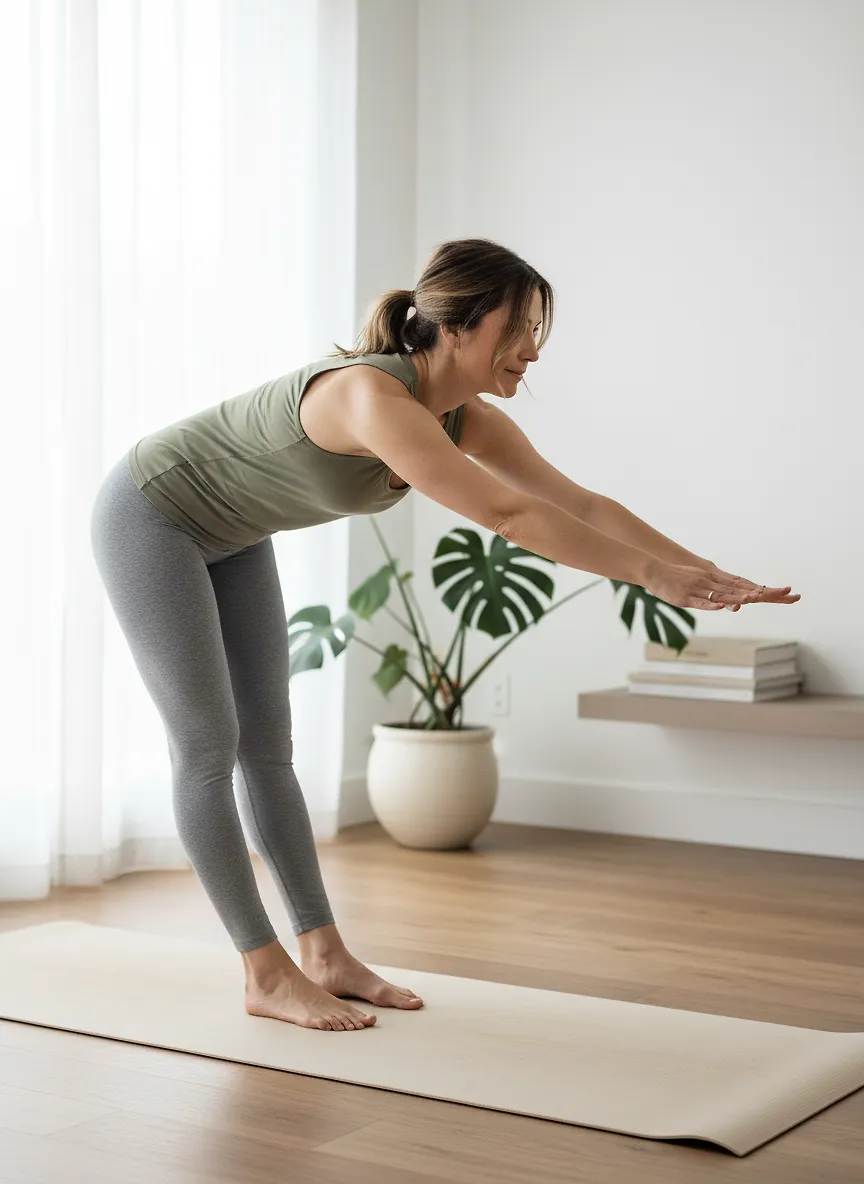
Let’s be real: some days, the thought of a single jumping jack is just too much. On those days, I opt for a 30-minute “Mind & Body” flow. This isn’t about pushing my limits; it’s about gentle movement, stretching, and reconnecting with my body. I put on a calming playlist and move through a series of yoga-inspired poses like Cat-Cow, Downward Dog, Warrior I and II, and deep stretches like Pigeon Pose and Forward Folds. It’s a fantastic antidote to a day spent hunched over a laptop and has become one of my most cherished practical self-care rituals for overwhelmed working moms.
The “Just Get Moving” Method
This is my ultimate fallback for days when motivation is at an absolute zero. The only rule is to put on my workout clothes and move my body for 30 minutes. That’s it. Sometimes it’s a brisk walk around the neighborhood listening to a podcast. Sometimes it’s a dance party in the kitchen with my kids. Other times, it’s just putting on my favorite pair of supportive leggings for postpartum support and doing some foam rolling while watching TV. The point isn’t the intensity; it’s the act of honoring the commitment to myself.
How to Stay Motivated When Your Couch Is Calling
Knowing how to work out is one thing; actually doing it is another. Here are a few mindset tricks that keep me going.
You don’t have to feel good to start, but you almost always have to start to feel good.
Avery Sinclair
The “Get Dressed for Success” Trick
On days I plan a morning workout, I literally lay my workout clothes out the night before. On WFH days with a planned mid-day session, I’ll often put on my workout clothes in the morning. It’s a psychological trick—once I’m dressed for it, I’ve removed a major barrier to entry. It feels silly to get to noon and then change *out* of my activewear without having done anything. My activewear has become an essential part of my daily uniform, functioning as an extension of my minimalist loungewear capsule wardrobe. It’s all about comfortable, high-quality pieces that make me feel good and are ready for action.
Track the Habit, Not the Performance
Forget tracking calories burned or miles run, especially at first. Instead, get a simple wall calendar and draw a big, satisfying ‘X’ over every day you complete your 30 minutes. After a week or two, you’ll have a visual chain of success. Your brain won’t want to “break the chain,” which can be a surprisingly powerful motivator on a low-energy day.
Redefine “Success”
Finally, and perhaps most importantly, change your definition of a “successful” workout. It’s not about how much you sweat or how heavy you lift. A successful workout is one that you did. It’s the one where you showed up for yourself, even when you didn’t want to. It’s the burst of energy you feel afterward. It’s the sense of accomplishment. It’s the stress that melts away. Focus on how it makes you feel, not just on the physical results, and it becomes a reward in itself.
A Sample Weekly Plan That Actually Works
To show you how this all comes together, here’s a peek at what a typical week might look like for me. Notice it’s a mix of intensity and includes rest—because recovery is just as important as the work!
| Day | 30-Minute Activity |
|---|---|
| Monday | HIIT Circuit |
| Tuesday | Brisk Walk Outside (Podcast Time!) |
| Wednesday | Mind & Body Flow (Yoga/Stretching) |
| Thursday | Active Recovery or Full Rest |
| Friday | HIIT Circuit or a Fun YouTube Dance Workout |
| Saturday | Longer Family Activity (Hike, Bike Ride) |
| Sunday | Full Rest / Gentle Stretching |
Fitting fitness into a busy life isn’t about a massive overhaul. It’s about small, smart, and sustainable choices. It’s about giving yourself grace and celebrating the act of showing up. That 30-minute window isn’t just another task to check off your list; it’s a powerful investment in your own well-being, a moment of calm in the chaos, and a gift you give yourself every single day.
Start small, find your sandwich, and see how 30 minutes can truly make all the difference.
With warmth and comfort,
Avery