Category: Work & Home

  • Finding My ‘And’: My Unfiltered Journey to Work-Life Balance

    Finding My ‘And’: My Unfiltered Journey to Work-Life Balance

    Finding My ‘And’: My Unfiltered Journey to Work-Life Balance

    The laptop was open to a half-finished business plan, my coffee was cold, and a tiny, sticky hand was methodically smearing yogurt onto my favorite pair of leggings. In the background, my email notifications were pinging with the frantic energy of a pinball machine. I remember sinking onto the floor, surrounded by the beautiful, chaotic mess of my life, and thinking, “This is it. This is what failing at everything feels like.”

    For years, I’d been on a quest for the holy grail of modern adulthood: work-life balance. I pictured it as a perfectly even scale, with a serene, productive workday on one side and a joyful, present home life on the other. But my reality was less a scale and more a wobbly, out-of-control seesaw, with me usually getting flung off the end. Every time I leaned into my work, guilt about my family crept in. Every time I fully unplugged to be with my kids, a nagging anxiety about my business would bubble up. Sound familiar?

    I was convinced I was doing something wrong. That somewhere out there, other entrepreneur moms had it all figured out. But the more I chased this elusive balance, the more exhausted and fragmented I became. This is the story of how I finally stopped chasing a myth and started building a reality that actually worked—by embracing the ‘and’.

    The Myth of the Perfectly Balanced Scale

    Before launching this blog, my life was in corporate strategy. It was a world of spreadsheets, five-year plans, and clear, measurable outcomes. I loved the order of it all. When I became a mother and then a founder, I tried to apply that same logic to my life. I color-coded calendars. I set rigid time blocks. I was determined to compartmentalize “Work Avery” from “Mom Avery.”

    The problem with the balance metaphor is that it sets up an inherent conflict. It implies that work and life are two separate, competing forces. For one to get more of your attention, the other must get less. It’s a zero-sum game, and in my experience, it’s a game you can never really win. You just end up feeling perpetually guilty, like you’re short-changing one part of your life to pay for the other.

    I’ll never forget the day I was on a “critically important” video call to close a partnership deal. My toddler, who had been napping, woke up with a fever and was crying for me just outside my office door. I could hear his little voice calling “Mama!” while I was trying to smile and nod and talk about Q3 projections. I felt my heart split in two. In that moment, I wasn’t a successful founder or a good mom. I just felt like a failure at both, stretched so thin I was transparent.

    Shifting from ‘Or’ to ‘And’

    The big shift for me didn’t come from a new planner or a productivity hack. It came late one night, after a particularly chaotic day, when I finally just… surrendered. I stopped trying to force my life into neat little boxes. I stopped seeing my roles as a founder *or* a mother.

    And I started to wonder: What if it’s not about balance, but integration? What if I could be a founder *and* a mother, at the same time, in the same breath? What if the skills I was learning from one role—patience, multitasking, crisis management (hello, toddler tantrums!)—actually made me better at the other?

    This was the beginning of my journey to redefining success. Success was no longer about a clean separation of church and state, work and home. Success became about creating a blended, cohesive life that felt whole and authentic, even if it looked a little messy from the outside. It was about finding the ‘and’. I am a dedicated entrepreneur *and* a present parent. My work is a part of my life, *and* my life enriches my work. It’s a subtle shift in language, but it changed everything.

    Practical Integration: How I Started Living in the ‘And’

    Of course, a mindset shift is only half the battle. I had to put it into practice. This wasn’t about finding one magic solution, but about a series of small, intentional changes that, over time, created a life that felt less like a struggle and more like a dance.

    Redefining the ‘Workday’ with Energy Blocking

    The 9-to-5 workday was designed for a world that doesn’t exist for most of us anymore. Instead of forcing myself into that rigid structure, I started listening to my own energy rhythms. I’m a morning person, so I now protect my early hours (from about 6 to 8:30 a.m.) for deep, focused work like writing and strategy. My kids are still asleep, the house is quiet, and my mind is sharp. Then, I can be fully present for the morning school-run chaos.

    My afternoons are for more collaborative tasks—emails, meetings, calls—that I can do even when my energy is a bit lower. And I build in a hard stop around 4 p.m. to be there for my kids after school, no apologies. Some days, I’ll hop back online for an hour after they’re in bed. Other days, I won’t. The key is flexibility and tuning into my energy, not the clock.

    Embracing the ‘Good Enough’ Philosophy

    As a former corporate strategist and a recovering perfectionist, this was the hardest one for me. But I realized that striving for perfection in every area was the fastest route to burnout. Now, I live by the “good enough” philosophy. The house doesn’t need to be immaculate; it needs to be a home. Dinner doesn’t have to be a gourmet meal; it just needs to be nutritious (and sometimes, that means breakfast for dinner or a healthy delivery service).

    Letting go of the need to do everything perfectly freed up so much mental and emotional energy. This shift was a huge part of my journey toward discovering practical self-care rituals for overwhelmed working moms. It’s about choosing what truly matters and letting the rest be ‘good enough’.

    Creating Boundaries with Simple Rituals

    When your office is ten steps from your living room, boundaries can feel impossible. But I found that small rituals can make a huge difference in signaling to my brain when the workday is beginning and, more importantly, when it’s ending. In the morning, it’s making a pour-over coffee and changing out of my pajamas into a comfortable but put-together outfit—usually a great pair of leggings and a cozy sweater. It’s a small act that says, “I am starting my workday.”

    The end-of-day ritual is even more crucial. I close my laptop—I don’t just put it to sleep. I tidy my desk. And I change my clothes again, usually into my comfiest sweats or loungewear. This simple change is my signal to fully transition into home mode. It’s a key reason I’m so passionate about building a minimalist loungewear capsule wardrobe; having dedicated pieces for rest helps create that mental separation.

    Weaving Movement into the Gaps

    Exercise used to be another item on my to-do list that I often failed to check off, leading to more guilt. Now, I see movement as a non-negotiable part of my integrated life—it’s what keeps my energy up and my mind clear. Instead of trying to carve out an hour for the gym, I weave movement into the gaps in my day.

    This might look like a 15-minute yoga stretch on my living room floor while my kids have screen time, taking a work call while walking around my neighborhood, or having a family dance party in the kitchen. It’s about finding joy in movement and releasing the pressure for it to look a certain way. I’ve found that learning how to fit a 30-minute workout into my busiest days was less about time management and more about a mindset of integration.


    This journey to find my ‘and’ is far from over. There are still days that feel like a chaotic mess of spilled yogurt and urgent emails. But the difference is, I no longer see it as a failure. I see it as life—full, rich, and integrated.

    My name is Avery Sinclair, and I am a founder *and* a mother. A writer *and* a lego-builder. A strategist *and* a professional snack-maker. And embracing the ‘and’ has been the key to not just finding balance, but finding joy in the beautiful, imperfect whole.

    With warmth,

    Avery
  • How to Create an Ergonomic WFH Setup in a Small Space

    How to Create an Ergonomic WFH Setup in a Small Space

    When I first traded my corporate office for a corner of my apartment, my initial setup was… let’s just say, less than ideal. I spent the first few weeks hunched over my laptop at the dining table, feeling that all-too-familiar tech-neck creep in by lunchtime. My back ached, my shoulders were tight, and my focus was shot by 3 p.m. I figured this was just the price of admission for the work-from-home life. But was it?

    It turns out, the answer is a resounding no. You don’t need a dedicated home office or a four-figure budget to create a workspace that supports your body instead of fighting against it. Your work-from-home setup shouldn’t be a pain in the neck—literally. After a lot of trial and error (and a few too many days feeling like a folded-up pretzel), I’ve discovered that creating a comfortable, productive, and ergonomic workspace is all about making small, intentional choices. Even if you’re working from a tiny nook in your bedroom or a sliver of your living room, you can transform it into a place that fosters focus and well-being.

    This guide is my playbook for doing just that. We’ll walk through everything from choosing the right chair (or hacking the one you have) to mastering monitor height and embracing simple tricks to improve your posture and energy throughout the day. Let’s make your WFH space work for you.

    The Foundation: Your Chair is Your Throne (Even a Makeshift One)

    Let’s be real: most of us living in apartments or smaller homes don’t have the space for a massive, executive-style ergonomic chair. And that’s okay! The goal isn’t to replicate a corporate high-rise office, but to support your body with what you have. The chair is the single most important piece of the puzzle, so it’s where we’ll start.

    If You Can Get a Dedicated Chair…

    If you have the budget and a little bit of space, investing in a decent ergonomic chair is a game-changer. You don’t need the top-of-the-line model. Look for these key features:

    • Adjustable Height: Your feet should be able to rest flat on the floor with your knees at roughly a 90-degree angle.
    • Lumbar Support: This is crucial. A good chair will have a curve that supports the natural inward curve of your lower back. Adjustable lumbar support is even better.
    • Adjustable Armrests: You want your arms to rest gently on them with your shoulders relaxed, not hunched. Your elbows should be at about a 90-degree angle.
    • Swivel and Wheels: These aren’t just for fun—they allow you to move freely to reach things without straining or twisting your body.

    And remember, ergonomic doesn’t have to mean ugly! There are so many stylish, minimalist options available now that blend beautifully into a modern home.

    Hacking Your Existing Chair for Maximum Comfort

    Okay, so what if a new chair isn’t in the cards? Welcome to the club! For a long time, my “office chair” was one of our dining chairs. Here’s how to upgrade whatever you’re sitting on.

    The Magic of a Lumbar Pillow: This is my number one hack. If you do nothing else, get a lumbar support pillow. It’s a small, inexpensive addition that makes a world of difference by preventing you from slouching and supporting your lower back. You can even roll up a bath towel and place it in the curve of your back in a pinch.

    Use a Seat Cushion: If your chair is too low for your desk, a firm seat cushion can give you the extra inch or two you need to get your elbows to that ideal 90-degree angle. It also adds a layer of comfort for those long meetings.

    Create a Footrest: Are your feet dangling? This puts strain on your lower back. The solution is simple: create a footrest. You don’t need to buy anything fancy. I’ve used a stack of old textbooks, a yoga block, and even a sturdy shoebox. The goal is just to have a stable surface where your feet can rest flat, keeping your knees happy.

    It’s All About the Angles: Desk & Monitor Placement

    Once your seating is sorted, the next step is arranging your desk area. The guiding principle of ergonomics is all about alignment. Think 90-degree angles at your elbows and knees, and a straight line from your head through your spine.

    The Laptop Problem (and its Simple Solution)

    I love my laptop for its portability, but it’s an ergonomic disaster. By design, if the screen is at the right height, the keyboard is too high, and if the keyboard is in the right spot, you’re craning your neck down to see the screen. Friends often ask me, “Avery, how do you manage in your apartment without a huge monitor?” and my answer is always the same: I separate my screen from my keyboard.

    This is the non-negotiable rule of a comfortable laptop setup:

    Elevate your laptop screen to eye level and use an external keyboard and mouse.

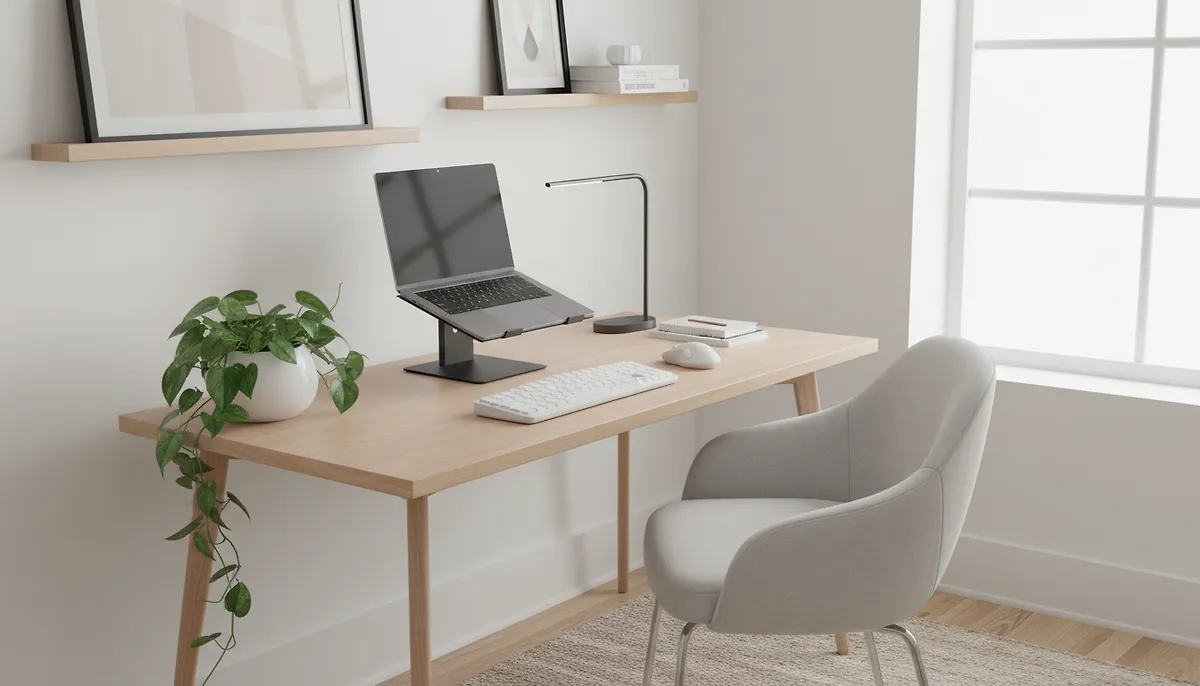
    You can use a dedicated laptop stand (there are tons of sleek, foldable ones perfect for small spaces) or get creative. For the first year of WFH, my personal, not-so-glamorous solution was a stack of my favorite cookbooks! It worked perfectly. The top of your screen should be at or just below eye level. This one change will eliminate that dreaded forward head posture and relieve so much tension in your neck and shoulders.

    Finding Your “Desk” in a Small Space

    Your “desk” might be a kitchen counter, a console table, or a corner of the dining table. The key is to make it work for you during work hours. If you’re using a multi-purpose surface like the dining table, create a ritual around setting up and packing away your workspace. This not only keeps your home tidy but also creates a psychological boundary between “work time” and “home time,” which is essential for balance.

    If you’re looking for a more permanent solution, consider a wall-mounted floating desk or a narrow “ladder” desk. These have a small footprint but provide a dedicated, defined workspace that can help you get in the zone.

    Beyond the Basics: Small Hacks for Big Comfort

    You’ve got your chair and your screen height sorted. Now for the finishing touches—these are the little things that add up to a much more comfortable and productive day.

    Let There Be (the Right) Light

    Eye strain is a major contributor to WFH fatigue. To combat it, pay attention to your lighting. Try to position your workspace perpendicular to a window (so the light is coming from the side) rather than directly in front of or behind it. This minimizes glare on your screen. In the evenings or on gray days, a simple, warm-toned desk lamp can provide focused light and make your space feel cozier while preventing you from straining to see.

    Movement is Medicine

    Even the most perfect ergonomic setup can’t beat the human body’s need to move. As a former corporate strategist, I used to think productivity meant being chained to my desk. Now, I know true productivity comes from balance.

    Embrace Micro-Breaks: Set a timer to get up and stretch every hour. Walk to the kitchen for a glass of water, do a few shoulder rolls, or simply stand up while you take a phone call. I live by the 20-20-20 rule: every 20 minutes, look at something 20 feet away for 20 seconds to give your eyes a break.

    Comfortable Clothes that Move: This is where my passion for high-quality essentials comes in. Just because you’re in clothes that feel like pajamas doesn’t mean you should be sedentary. In fact, a great minimalist loungewear capsule wardrobe should be comfortable enough to focus in and flexible enough for a quick midday stretch or a walk around the block.

    Taking these small breaks isn’t a luxury; it’s a non-negotiable part of a sustainable work-from-home routine. It’s one of the most effective forms of practical self-care for busy professionals you can practice. Your body—and your brain—will thank you.


    Creating an ergonomic setup in a small space isn’t about achieving some Instagram-perfect ideal. It’s about listening to your body and making small, iterative adjustments that add up to a big difference in your daily comfort and long-term health. It’s about being intentional with your space so you can end the workday with energy left over for your family, your hobbies, and yourself.

    Here’s to a workday that feels as good as it is productive.

    All my best,
    Avery